ENFORCEMENT BEGINS MARCH 2026
Lexalign is Uniquely Focused on Your ACH Originators & TPSs
The Nacha Fraud Monitoring Rules require every non-consumer Originator and TPS to implement risk-based fraud monitoring. Nacha has signaled that they are looking to the ODFI to empower and assess their customers’ compliance.

ON DEMAND WEBINAR
A Practical Approach to Originator Oversight in Time for New Nacha Rules
Be ready for the June 22 compliance deadline. As the ODFI, learn how to demonstrate with audit-ready records that you've met Nacha's "appropriate oversight" verification standard regarding your Originators' compliance with the Nacha Rules, including the new Fraud Monitoring Rule.
WATCH
4 Boxes to Check for Nacha's 2026 Fraud Monitoring Rules
Learn the full scope of what the Rules require and the toolkit you'll need.

FREE GUIDE
Download the Guide: 4 Boxes to Check for Nacha's 2026 Fraud Monitoring Rules
LexAlign is a Preferred Partner for Compliance, Fraud Monitoring, and Risk & Fraud Prevention.
Your Originators are Responsible for Compliance
Originators and Third-Party Senders must establish and implement risk-based processes and procedures to monitor for unauthorized or deceptive (“False Pretenses”) payments — and review them annually.
Doing Nothing Will be Unacceptable
Nacha’s Risk Management Advisory Group (RMAG) also emphasizes that simply doing nothing is not acceptable—risk monitoring must be meaningful, documented, and operational.
Enforcement began March 20, 2026
Effective March 20, 2026, the Rules became enforceable as to non-consumer Originators and Third‑Party Senders (TPS) that originated more than 6 million Entries in 2023. On June 22, 2026, enforceability extends to all remaining Originators and TPS.
GET READY FOR THE NEW RULE
Lexalign Operationalizes the "Verified by Appropriate Oversight" Standard
In its Phase 1 FAQs, Nacha articulated a new standard they expect ODFIs to meet for reliance on other parties fraud monitoring, including their Originators’ compliance with the New Rules: “verified by appropriate oversight.”
Lexalign operationalizes the standard as it relates to Originators and Third-Party sender fraud monitoring.
THE CHALLENGE:
Nacha Will Require Risk-Based Fraud Prevention at the Customer Level
Most customers lack bank-level sophistication — 79% reported fraud attacks in 2024, yet there’s been a 30% drop in the number maintaining minimal viable security. Nacha now requires risk-based fraud prevention at the customer level.
THE SOLUTION: Customer Fraud Monitoring Readiness

Lexalign empowers customers to identify and remediate the gaps in their compliance.
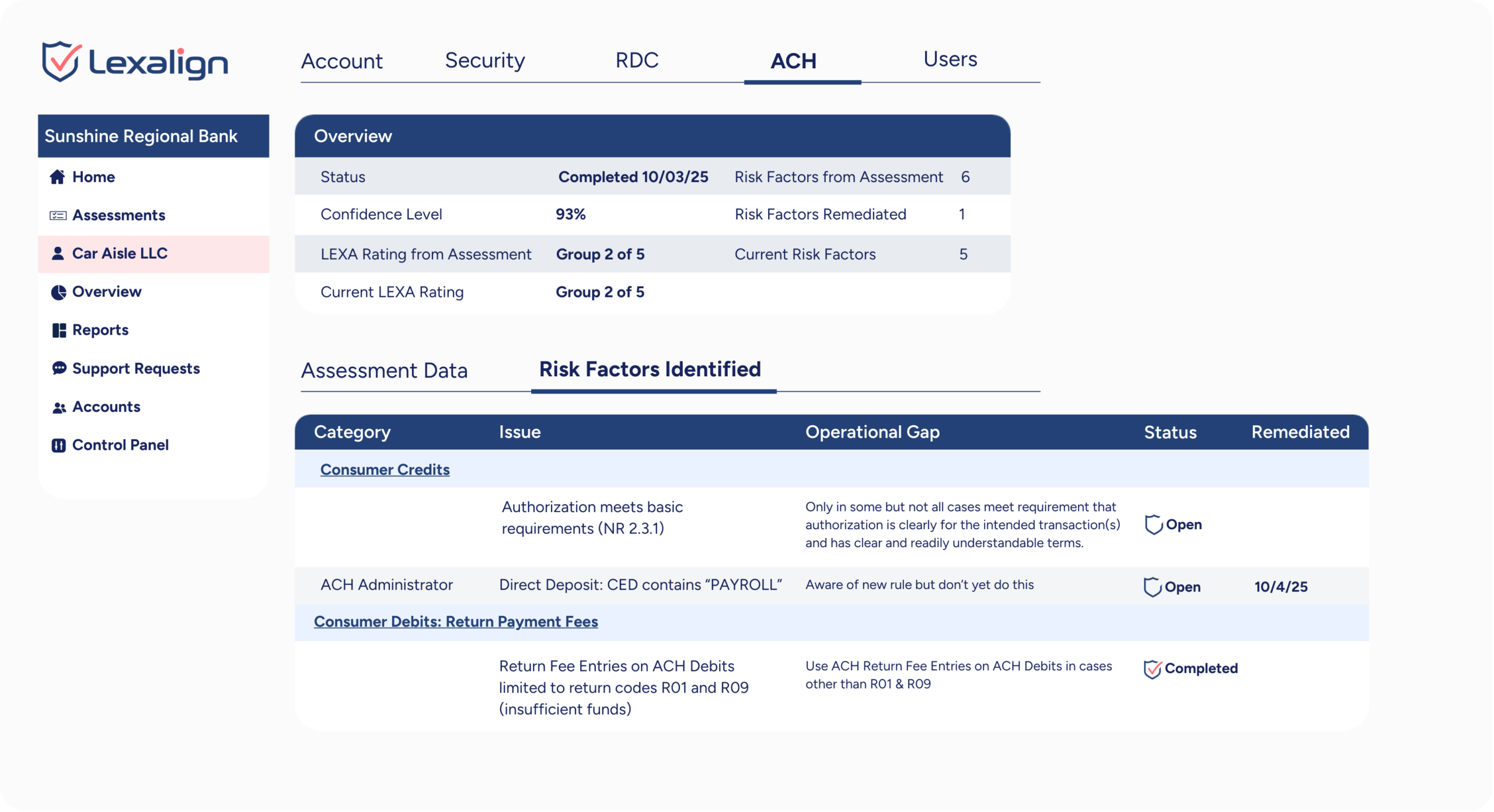
Your customers receive guided self-assessments and uncover gaps
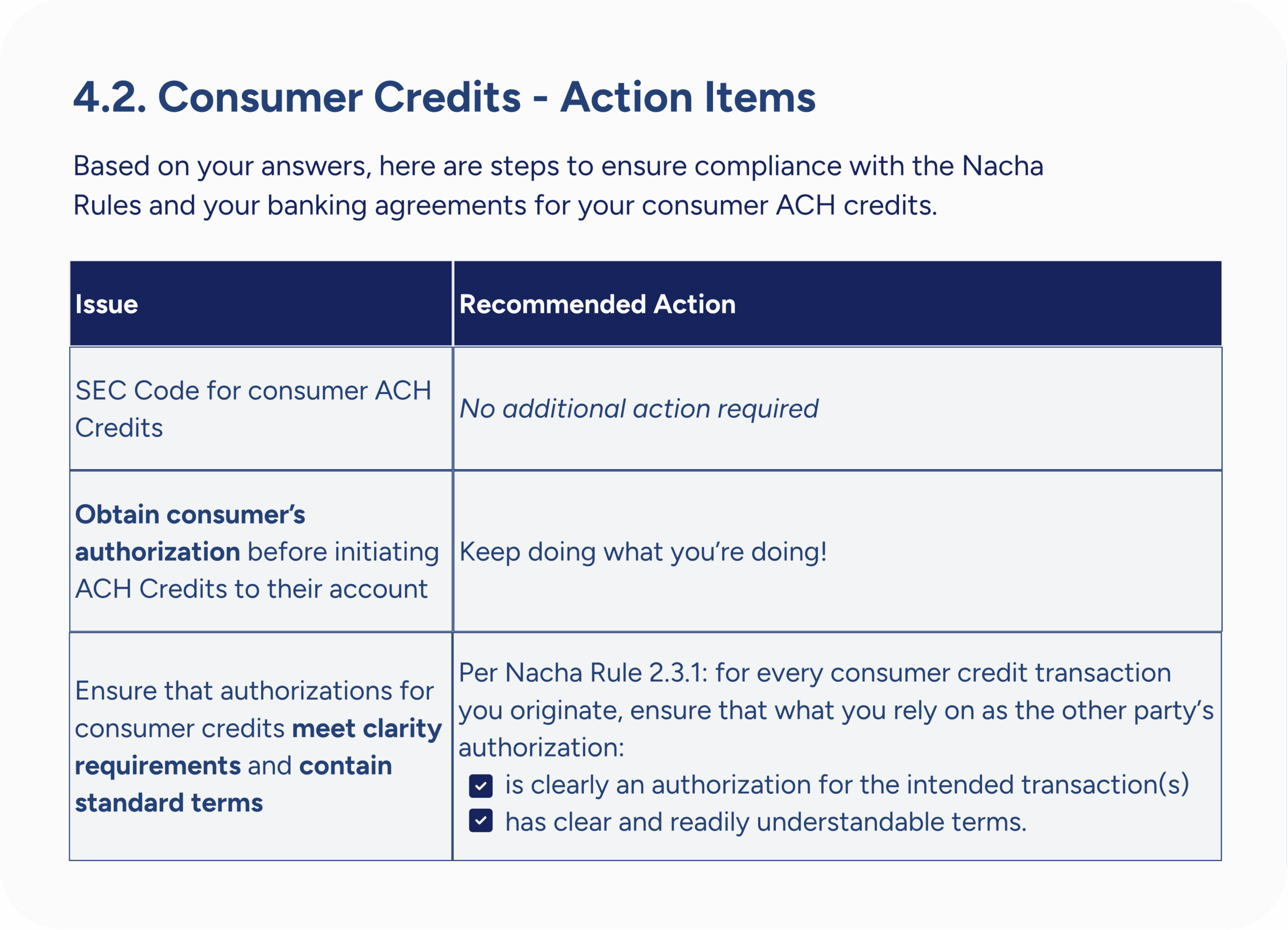
With Lexalign, your customers receive an interactive, remediation checklist to track and attest to fixes.
THE CHALLENGE:
Attestations and agreements don’t discharge ODFI responsibility under the Rules, according to Nacha.
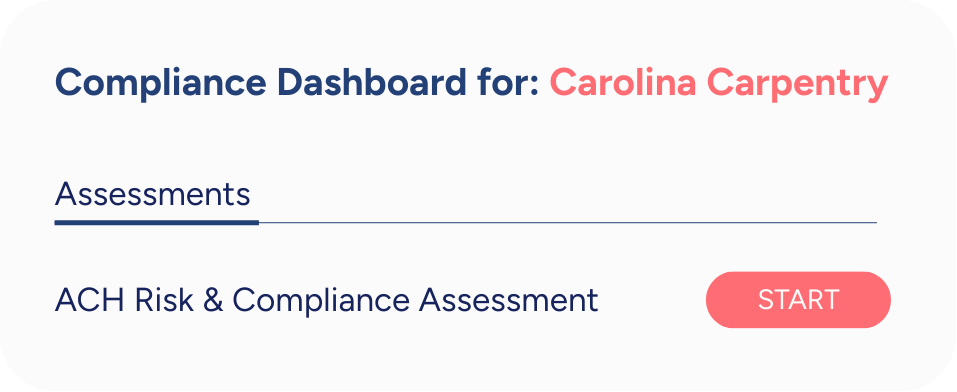
Compliance requires records. Without defensible documentation, compliance “didn’t happen.” With Lexalign, ODFI customers receive:
THE SOLUTION: Records that Evidence ODFI Responsibility
With Lexalign, ODFI customers receive the following support in line with the Nacha Operating Rules and the Rules of Evidence:
Actionable Reports
Dashboards
Scoring
Analysis
THE CHALLENGE:
Fraud exploits gaps banks can’t see: deficient controls at the site of origination — your customer’s operations.
Lexalign Audit Reports protect banks from fraud-related liability more effectively than agreements under pertinent statutes.
THE SOLUTION: Visibility Into Customer Operations
Customers complete self-assessments against the Rules and instantly obtain actionable Audit Reports
ODFIs get visibility into 80%+ of customers’ operations

On average, Lexalign users enjoy 80% assessment completion from customers

Your customers are given the tools they need to remediate their gaps.
THE CHALLENGE:
Identifying risks isn’t enough — customers need practical steps to remediate.
With Lexalign, the banks’ customers receive tailored a complete ACH Compliance Program:
THE SOLUTION: Actionable Gap Remediation
Gap Analyses & Action Plans
Policies & Procedures
Remediation Checklists
THE CHALLENGE:
ODFIs are still responsible for all originated Entries. Without proactive oversight, fines, fraud losses, and reputational risk flow upstream.
Lexalign operationalizes compliance, empowering customers to prevent fraud while enabling banks to grow faster and safer with Lexalign.
THE SOLUTION: Bank-Level Confidence, Customer-Level Action
Regulatory Alignment
Risk-Based Oversight
Low-Risk, Scalable Growth
Stronger Customer Relationships
Are You Ready for the New Rule?
Below are some resources that will help you and your team prepare your customers for Nacha’s new Fraud Monitoring Rule. Rules enforceable starting June 22, 2026.

ON DEMAND WEBINAR
The Hidden Business Case in Tooling Up for the New Nacha Fraud Monitoring Rule
Get ahead of Nacha’s new Fraud Monitoring Rule taking effect in March 2026. Learn how empowering Originator and TPS compliance can drive growth, generate non-interest income, and improve efficiency—all while meeting your own compliance obligations.
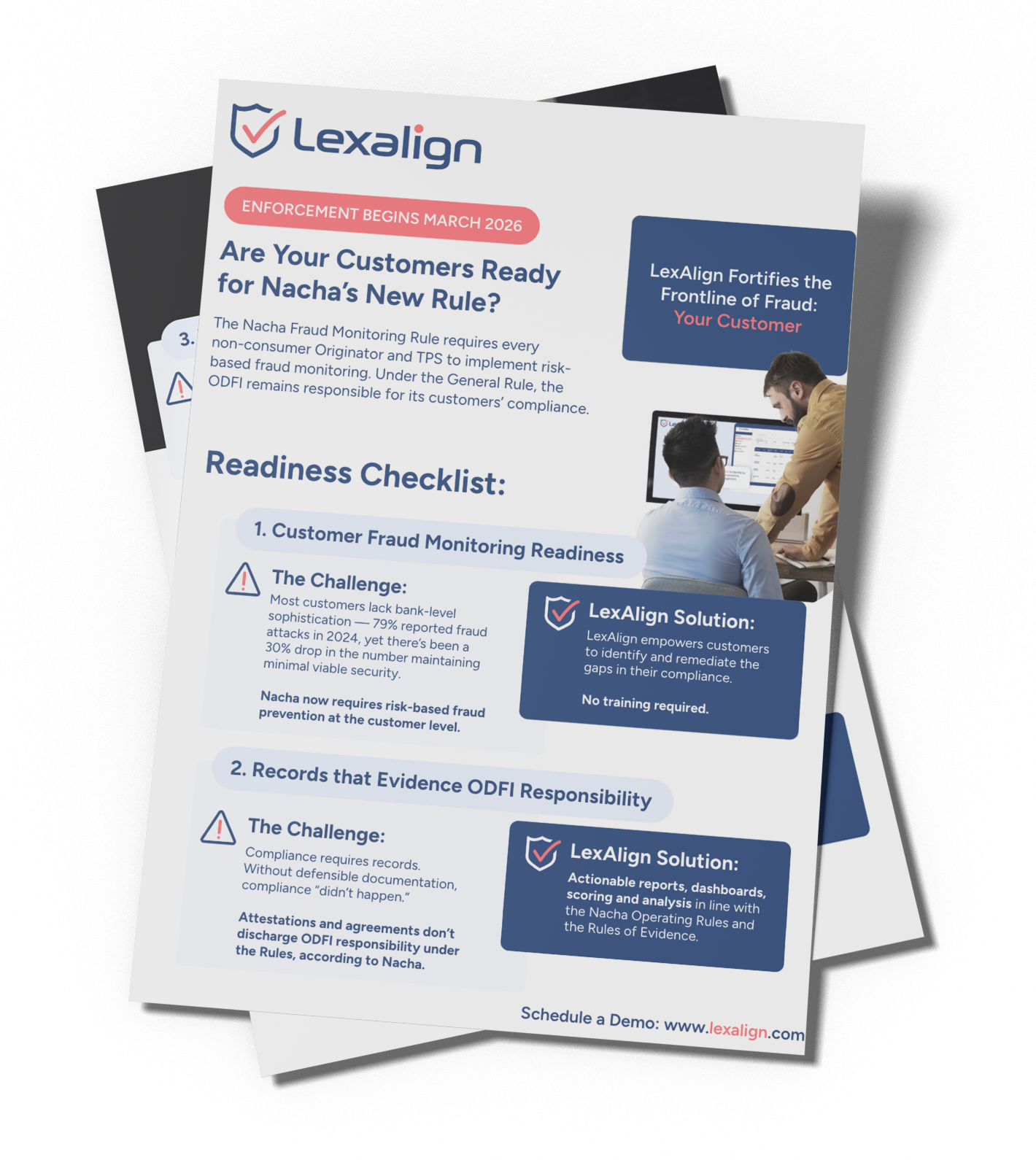
Are Your Customers Ready for the New Rule?
Download our Nacha New Rule readiness checklist to learn more about how you can be ready for the New Rule by March 2026.
Articles










LEARN MORE
Contact Us
Discover how Lexalign can streamline your workflow, reduce compliance risk, and empower your team to move faster with confidence.
Whether you’re exploring solutions or ready to upgrade your process, our product experts will guide you through a personalized walkthrough tailored to your needs.
Customers




Nacha Chose LexAlign as a
Preferred Partner for Compliance, Fraud Monitoring, and Risk & Fraud Prevention.
With LexAlign, banks don’t just “check the box” on compliance. Nacha chose LexAlign because our customers are empowered to…
Empower Customer Compliance
LexAlign identifies rules & risks specific to the customer and assesses their compliance and ability to manage the risks with actionable tasks.
Strengthen Customer Defenses Against ACH Fraud
Customers instantly get an audit report, policies, and an interactive checklist — turning vague compliance rules into clear, step-by-step actions.
Reduce Exposure to Liability When Fraud Occurs
LexAlign helps reinforce fraud defenses at the customer level and provides defensible records that satisfy examiners — reducing bank exposure under Nacha’s new rule.
Audit-Ready Compliance Records for Examiners
Get reports, policies, and remediation checklists — creating defensible, audit-ready records that examiners expect and regulators recognize as proof of compliance.